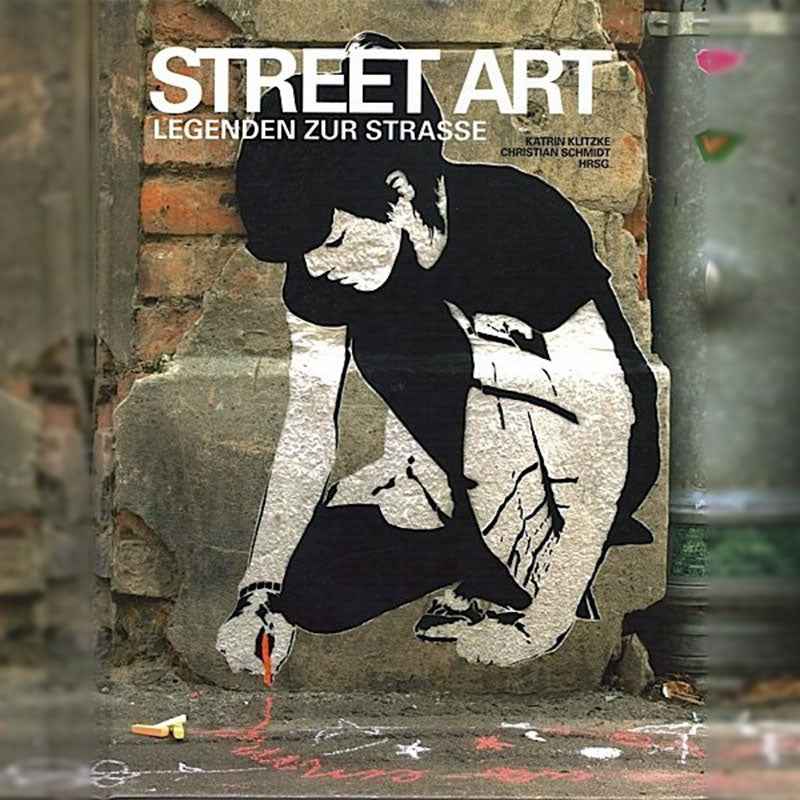
Street Art - Legends of the Street Book (Katrin Klitzke / Christian Schmidt)
Street Art - Legends of the Street Book (Katrin Klitzke / Christian Schmidt)
Couldn't load pickup availability
Description
Much has been written about Street Art in recent years, both from outside and within the scene. "Street Art. Legends of the Street" attempts, through a collaboration between active street artists and observing academics, to interweave both perspectives for the first time. While artists process their experiences and stories from the street in the form of literary and graphic contributions, researchers from various disciplines, in the form of essays, make this pop cultural phenomenon understandable to outsiders within its social, political, historical, and cultural context. The publication thus offers "legends of the street" in a dual sense: on the one hand, as narrative "legends" of street artists working on the street, and on the other hand, as explanatory "legends" for a better understanding of these illegal interventions in urban aesthetics.
Interviews with the editors: 13seiten.com and with jetzt.de
“If there were a rating system here, I would give the title eleven out of ten points.”
Stylespion
“At first I thought: Oh, no, not another street art book. There has simply been an overkill of pseudo-post-graffiti books in recent years, for which some second-rate photographer strolled through the streets of Berlin, photographed everything that looked like a poster/sticker/stencil, and sold it to a publisher, panting for subversive and rebellious themes, as new, hot stuff from Berlin. Then the surprise: 'Street Art. Legends of the Street' has not become a picture book, but a real reading book. Finally, someone has understood that the phenomenon of street art still lacks theoretical substance. The book is absolutely worth reading! – probably the first comprehensive theoretical work on the subject of street art.”
rebelart.net
“Very worth reading and seeing!” Radio Fritz (www.fritz.de)
“Atelier Straße. The Archive of Youth Cultures in Berlin is known for its high-quality publications. With 'Street Art – Legends of the Street,' a lively and extremely readable anthology on the broad field of street art is now available, which attempts to interweave both perspectives through a collaboration between active artists and observing academics.
Experience reports from the scene and essays from the ivory tower, combined with ample photos, mainly from the federal capital, combine to create an entertaining read for eyes and brain. The social, political, historical, and cultural context of this illegal art is clarified, as are the mundane technical requirements and hurdles faced by the protagonists.
The variety of written expressions is also appealing, from letters to plays and photo novels. And the most important thing, of course: The volume shows many great pictures that, in addition to all the art, simply make you want to visit Berlin again.”
Neue Szene Augsburg
“At first glance, it seems difficult to convey both the scientific perspective and the perspective of those who are passionately involved to the reader equally, while also doing justice to dissenting voices. But the authors and editors succeed in this balancing act. As a beginner, one understands a lot better after reading this book, and even readers who are already well-versed in the field will learn and discover new things.
There is a lot to discover in the book: Not only new perspectives and information in the texts, but also the many pictures offer much new and encourage you to walk through the streets with open eyes in the future. In many places where you wouldn't expect it, street art is hidden.”
Anja Thiemé in: www.media-mania.de
“A book for poster-pasting and strolling
STREETART IS NOT
– anything but art seen + performed in the streets.
– published in this book, nor in any other book or magazine on the topic.
– being auctioned or bought.
– to be found in galleries or museums.
– collectable.
– more than a offer.
– a profession.
– design or stupid self-advertising
– graffiti. But graffiti can be streetart.
…anything more than a label that people stick on us, to feel more comfortable. Just take it off + burn it. It might keep you warm for a while…
NOMAD
A strange foreword for an anthology on street art, but in this case, a groundbreaking one. "Street Art. Legends of the Street" does not aim to be a DIY textbook or an art coffee table book, but a travel guide, because adventure awaits outside the door. Those who turn the page – instead of reaching for a lighter as recommended – will find 32 very different approaches.
The collection of texts playfully mixes scientific texts with theme-inherent photos. In addition, there are the legends promised in the title in the form of essays, reports, and narratives by the "artists." Street art is for all of us, that's the tenor. This is the second book in the Verlag Archiv der Jugendkulturen after Die Stadt als Spielplatz (2006) to deal with urban art phenomena, and it comes at a time when cut-outs and graffiti, posters and stickers in public space are no longer new and innocent, but are, for example, being preserved from decay on glass walls in London by works of Blek le Rat.
However, not only city marketing but also gallery owners and fans fight with their respective means against the melancholy of transience. The latter use their camera as a weapon against fading, weathering, the moment – a now well-established cultural technique. Photos are uploaded to blogs like www.woostercollective.com (venerable subtitle: A Celebration of Street Art), viewed globally and archived. The digital honorary cemetery of the swept away and pasted over certainly finds predecessors in the Archive of Youth Cultures in the field of hunting and collecting.
And we are already on the street. Honestly, who hasn't tried to bring a particularly beautiful specimen from the brittle wall indoors? The author Heike Derwanz, at any rate, tried in vain and found comfort in Japanese aesthetics. The charm of transience particularly convinced her. Her love letter to transience is therefore both pragmatic and tender. The art historian Anika Lorenz, on the other hand, has a purely objective perspective. She debunks the legend of new art that fell from the sky at the turn of the millennium to color all the gray of the city/building/decay. No, it all began with a hand as a stencil on the cave wall of our ancestors. The urban mural has deep roots. But the classification of street art is difficult, says Lorenz in accordance with the initial quote, because street art combines elements from artistic, political, subcultural, social, and activist movements. "This allows it to be many things at once: playful like Dada, politically agitating like the Situationists, advertising-aesthetically striking like Pop Art, or territory-marking and name-focused like graffiti writing." Speaking of writing: An artist conceived a small utopia where police officers are nice and helpful. All Cops Are Cool. What would happen in this world with the widespread ACAB tags?
Warning: The book is an amuse-bouche! And it tickles the mind and feet while reading.”
Juliette Kaiser in: Leipzig-Almanach
“Finally a publication that really takes the phenomenon of Street Art seriously, not just showing and describing it, but also questioning and explaining it. Because the extent of its spread and the resilience with which Street Art is globally asserting itself reflect the problematic state of this urban world and bear witness to hidden mechanisms that virtually conjure up the emergence of spontaneous youth cultures. In previous volumes such as 'Street Art: The City as a Playground' and 'Street Art: A Subculture Between Art and Commerce', the foundations for a complex approach to the topic have already been laid. This volume builds on what has been started and goes further by combining various contexts – art-historical, socio-cultural, political, and ethnological – while skillfully incorporating illustrative, authentic, and playful elements such as documents, photos, insider reports, film stills, and literary texts. This creates a journalistic kaleidoscope, equally exciting for fans and adversaries and in the best form. First choice.”
Danuta Springmann in: ekz-informationsdienst
“Scientists, of all people, are supposed to explain the phenomenon from an external perspective? But the concept works. In the form of essays, a number of young scientists dedicate themselves to the object 'Street Art' according to their field. Sociology, geography, art history, and many more are represented. On 225 pages, an overview emerges from 'How authentic is street art in a gallery?' to its integration into advertising and thought-provoking walks through Berlin. But artworks and impressions from London and New York are also discussed in the volume.
Viewing street art as a purely scientific topic from the outside initially sounds like stifling a living art, fixing it, and destroying its further development and thus its existence. However, the approaches are diverse and go far beyond a mere description. What could have turned vibrant street art into a dry panorama is transformed into a lively discussion by the second level of the book. Klitzke and Schmidt succeeded in getting street artists to contribute to the book. The self-reflective texts by the artists, ranging from a 'Street Art Musical' to poems and mini-newspapers, provide the reader with a glimpse behind the scenes.
The book offers something for almost every reader who delves through the initial, rather scientific essays. Never heard of street art? Banksy is an unknown word? Here's an overview. Those who are already fans will discover new perspectives. Looking for a master's thesis topic? Here are some approaches.”
Janina Guthke in: Der Tagesspiegel
“More, more! One wants to exclaim.” More at: www.schenken.net
“Street. Art. My ass. There can't be many terms that have been hyped so much in recent years, that have been glorified so much as a symbol and synonym for authenticity, urbanism, and rebellion. Street art is dead. Dead as a doornail.
Katrin Klitzke and Christian Schmidt understood that this conclusion is unfounded, and printed the unword in bold, white Helvetica letters on the cover of their book. "Street Art – Legends of the Street" deals with the topic at a serious and respectable level. Whoever opens the book cover will indeed find a "journalistic kaleidoscope," as the editors describe it in their foreword, and quite a surprising one. The concept is the risky encounter of art and science. Art historians, sociologists, geographers, ethnologists, and philosophers analyze the art movement of street art in lengthy essays, meticulously substantiating their statements with cross-references to scientific literature and thereby ultimately canonizing the often ridiculed street art to the status of a cultural-historical research object. This sometimes brings more, sometimes less new insights to light, often feels like a belated satisfaction, and at the same time appears so overly intellectual in places that one catches oneself muttering a contradiction. Nevertheless, this is what is new and innovative about "Street Art – Legends of the Street": The honest, high-level, and long-overdue examination of the first global cultural phenomenon of the 21st century. The essays oppose the we-are-young-and-funny attitude with depth, reflection, and classification. They place the supposedly insignificant stickers, stencils, and posters in context and relation to past art movements, to globalization and gentrification. This distinguishes the book from other publications on the subject; it does street art a service instead of enriching itself from it.
Had it remained a collection of academic texts, the book could just as well have been published by Reclam Verlag. But "Street Art – Legends of the Street" has several other pages whose content was designed by artists. The protagonists of the urban Berlin art scene, Tower and Bronco and Evol and Gould and Boxi, are all represented. This is not creative incest; each artist justifies their mention by the quality of the printed works. Bronco's text "Street Art: The Musical," for example, leaves the reader with a mixture of speechless admiration and a latent inferiority complex. Evol, with the photos of his "Search for Traces," shows a concept of "Street Art" that has nothing to do with stencils or paste. And Klub7 meticulously guides through the creation process of a paste-up, from the initial idea, through conception, to the finished image on the wall. This mixture of scientific essays and artistic works enormously loosens up the book, especially because the direct juxtaposition of gravity and lightness appears so bizarre.
"Street Art – Legends of the Street" has not become a coffee table book. The editors did not make it easy for themselves and did not simply produce another pretty but hollow street art book that is supposed to bring the obligatory street credibility into oh-so-hip bookshelves. Instead, it has become a keyword provider for people who reflect on their everyday environment. A travel guide that proposes a legend that everyone can transfer to their own city map. A legend of the street.”
Lukas Kampfmann in: proud. Berlin-Lifestyle Cross Media Magazin
Share