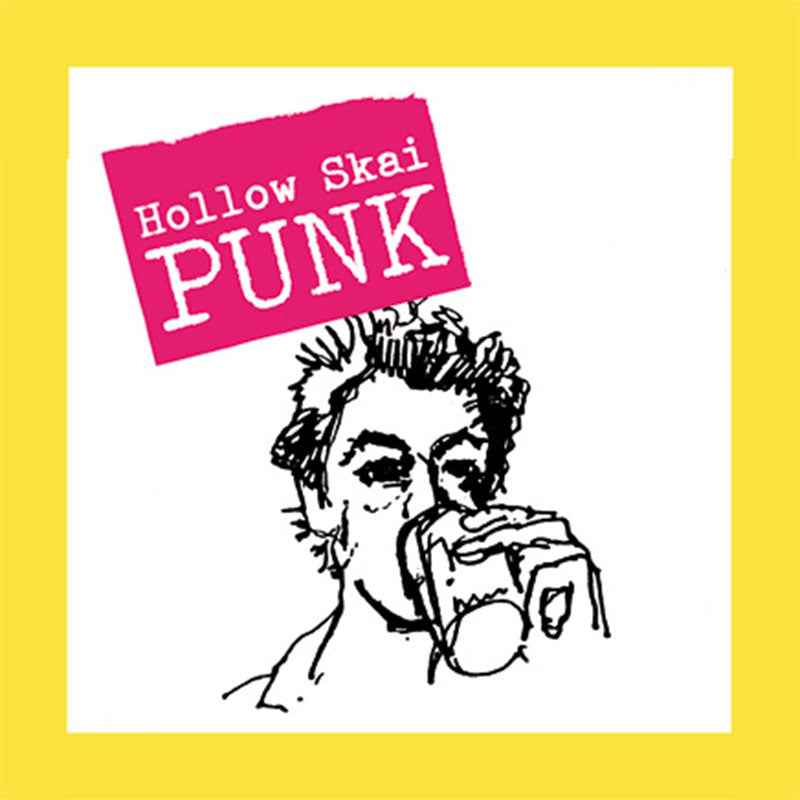
Punk - Book (Hollow Skai)
Punk - Book (Hollow Skai)
Couldn't load pickup availability
Hollow Skai:
PUNK
An Attempt at the Artistic Realization of a New Attitude to Life
PUNK
An Attempt at the Artistic Realization of a New Attitude to Life
July 2008, 272 pages, 168 illustrations, hardcover
Description
Master's thesis at the German Faculty of the University of Hanover
“Anyone interested in punk, whether for academic reasons or in search of authentic orientation, will find the true roots of the punk movement in (West) Germany in the late seventies here. You don't have to be a punk to like this book.”
Enrico Damme, in: Corax
“You don't have to be a punk and you don't have to have ever considered yourself part of this subculture to like this book. It offers an impressive insight into the early days of a scene that, after thirty years, has transformed into an integral part of the subculture cosmos. Hollow Skai's language back then wasn't tied to scientific pomposity; rather, he told more than he described. Thus, his book becomes an entertaining journey through time into the late 70s and early 80s, swiftly written and interestingly illustrated in an impressively well-designed hardcover edition.”
Klaus N. Frick in: www.perry-rhodan.net
Punk was once more than just music, more than just business, more than the uniformed expression of a new youth culture. Therefore, this is not about explaining the punk phenomenon, but rather this "scientific/literary curiosity" (Augsburger Allgemeine), first published in 1981 and supplemented with a few "bonus tracks," sees itself as both a manifesto against the monarchy of everyday life and a quasi-eulogy to the great Nordstadt hoax.
"Hollow Skai is considered one of the very few people who have succeeded in carving out a niche from the monopoly of multinational media corporations and their industrially standardized cultural products, where the 'new attitude to life' can find its cultural expression."
Michael O. R. Kröher
“Like so many bespectacled punk rockers after him, Hollow Skai probably wanted to have fun at least once during his studies and therefore made his life's passion the subject of his master's thesis. But unlike other nitwits, he didn't approach the matter with the seriousness required, but instead thumbed his nose at academia. Respect! What appears to outsiders (professors) to be quite serious, because 'Punk' is well-founded and plausibly written in terms of content, is 'total mockery' (Normahl) for insiders, because Hollow Skai allowed himself to include far-fetched gimmicks. For example, he quotes himself (from his No-Fun-Zine) or friends (to whom he simply put words in their mouths), solely for the reason that he could list them in his bibliography.
Did Hollow Skai, incidentally the founder of the venerable No-Fun label, betray punk rock in Germany in its very early years? No, he rather erected a monument to it, which hopefully will leave as many people puzzled as they once were by the Berlin Wall. The high number of pages for a master's thesis is relativized by the fact that the book contains both the pure text and a faithful reproduction with a very stylish punk layout of the master's thesis. Punk rockers, of course, read the almost comic-like original, students read the plain text. In terms of content, the individual chapters deal with the origins and meaning of punk, the ideology behind it, punk fanzines, the connections between boredom and destruction in punk, gender roles, punk fashion and its background, and so on. As a bonus, at the end of the book there are a few 'bonus tracks' that Hollow Skai published about punk over the later years. All of this includes many photos, collages, and other stuff. As a result, this book can bring a lot of joy to those with sufficient mental maturity, and it should.”
Obnoxious in: Punkrock!
From Real-Time – Hollow Skai's Punk Analysis from 1980 in a New Edition
By Martin Büsser (in Junge Welt of 11.11.08)
Meanwhile, there are numerous books about punk; the history has been thoroughly explored. The punks of yesteryear are now over forty and gladly invest a Euro or two to reaffirm the significance of their youth. The problem with these books, however, is that they are written in retrospect. They no longer have to convey the cultural and musical-historical importance of punk to readers, as this is no longer doubted by anyone. This was different in 1980, when Hollow Skai published his thesis in German Studies on the topic of punk. In Germany, punk was anything but dead at that time; rather, it was just beginning to rage properly and divide youth – into punks, preppies, eco-activists, and old rockers. Hollow Skai himself was actively involved in the rapidly spreading scene and had founded the "No Fun" label in Hanover, where records by Hans-a-Plast and Rotzkotz, among others, were released. Therefore, there can be no talk of a scientifically detached view of punk in his master's thesis. Large parts of his work are not only visually designed like a punk fanzine but also written in a fanzine style, full of subjective declarations that one is actually drilled in the first semester to avoid in an academic paper. But Hollow Skai goes on a collision course from the beginning: "Punk makes contradictions transparent and alive. But: does it matter? Can this be the purpose of a scientific (with all due respect: puke... gag...) work?"
read more:
“We don’t need books about punk.
We need punk books.
To put it briefly: Hollow Skai’s "Punk – An Attempt at the Artistic Realization of a New Attitude to Life" is not a book about punk. It is punk.
So, if you're looking for nice anecdotes from the wild times back then to tell at the next indie regulars' table, you won't find anything here. No lists of band members, no discographies of the most important records, no glossy photos. No, that's not a shame.
Because this is, for once, not one of those publications that outdo each other in portraying the "good old days" as even more heroic, authentic, sometimes even more political, while simultaneously trying to show today's youth their consumption-ridden and unmotivated existence. The fact that "Punk" doesn't even come close to the "I used to be a punk myself and now I'll show today's boys and girls how things were for us" books is primarily due to its genesis. The story goes a little bit like this: German studies student Holger Poscich faced the great problem of every student in the winter of 1979/80: his studies were nearing their end, and a final thesis was needed. Poscich – already clearly influenced by the still young punk culture – decided to bring together the incompatible: a scientific work on punk using punk methods. For him, as a fanzine editor, this meant cutting, scribbling, and of course, copying. The result was a master's thesis that contained significantly more punk than science; no matter, Poscich passed with a "good" (tip for the next life: study German!), founded a record label (No Fun Records, which released such illustrious bands as Hans-a-Plast, Rotzkotz, Bärchen und die Milchbubis, or Mythen in Tüten), worked for the Hanover city magazine Schädelspalter, later as a culture editor for stern, and and and: Happy End.
Poscich's or Skai's "scientific/literary curiosity" (Augsburger Allgemeine) was already published in 1981 by Sounds-Verlag; now the Archiv der Jugendkulturen in Berlin has reissued it in a high-quality edition. In addition to the original manuscript as a facsimile, this volume also contains the complete text in an edited version, which greatly facilitates readability (Musik-Express certified Skai's original version of "Punk" as having the "highest error rate since the invention of alphabetic writing" and is almost certainly correct in this).
Certainly, one doesn't (anymore) encounter any major novelties in this foundational work on punk culture from 1979. However, even today – 27 years after its first appearance – there is hardly anything to read that captures the punk attitude to life (music, fashion, art, politics) in this form so precisely. In this sense, "Punk – An Attempt at the Artistic Realization of a New Attitude to Life" is not a scientific essay that can explain this or that about punk. This book is a historical document and a manifesto. It is punk, and that in its original sense, that it is better to do things than to talk endlessly.”
Tobias Schärtl in: www.zyva.de
It's amazing how many complex topics are still debated today – e.g., sexism in the scene – that were already an issue back then. Primarily, the work is very exciting to read as a historical document. How does a Germanist and political scientist write (and reflect) about punk in 1979, at a time when he himself is part of the movement? All in all, a beautiful historical document for a punk-enthusiastic (and interested in its background) readership.
Maurice Schuhmann in: http://cultureglobe.de/
Share